

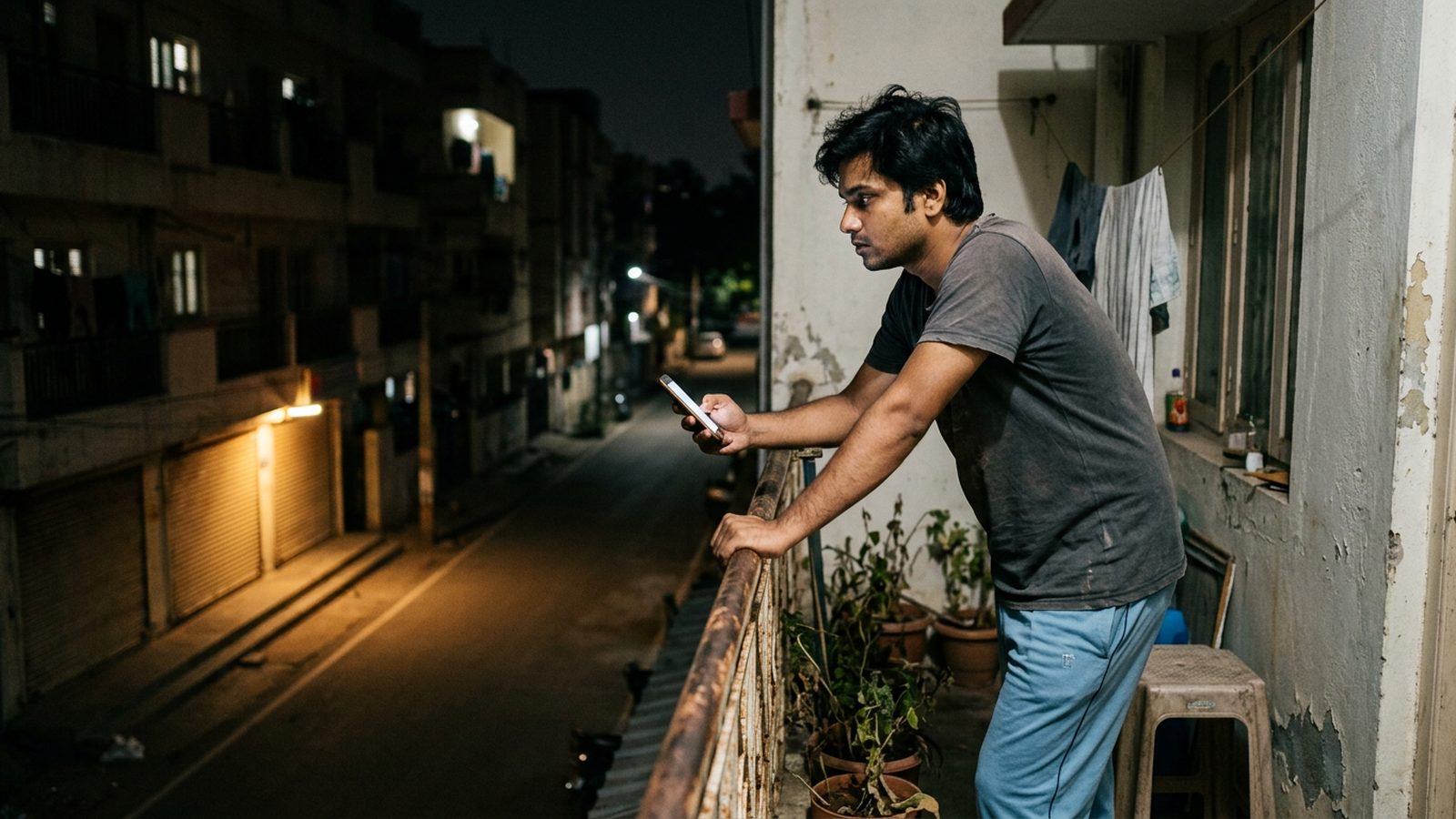
Why the silence hits harder than the day
During the day, your mind has a job: reply to this message, finish this task, get through this meeting. At night, that structure disappears. There's no inbox to check, no one to small-talk with in the lift, nothing external telling your brain what to think about next. Whatever you were pushing down has an open field to run in.
There's also a practical piece: the people you'd normally message are asleep, at a different point in their own night, or simply unavailable in a way that feels different from being busy during the day. Daytime unavailability reads as "they're at work." Night-time unavailability reads as "there's no one." That distinction makes the same amount of actual aloneness feel much bigger after dark.
Loneliness itself is a serious enough pattern that the World Health Organization now treats it as a public health issue, not just an unpleasant feeling. Its 2025 Commission on Social Connection report found that people who feel lonely are about twice as likely to become depressed over time, and that roughly 1 in 6 people worldwide are affected by loneliness at any given point (WHO, June 2025). If 1 am has become a recurring low point for you and not an occasional one, that's worth taking seriously rather than waiting out.
What to do right now, tonight
- Name what you actually need. Do you want to talk, be distracted, or just fall asleep? Each needs a different next step, and guessing wrong wastes the little energy you have left.
- If it's distraction you need, change your body before your screen. Get water, step onto the balcony, splash your face. A small physical reset often does more than another ten minutes of scrolling.
- If you need to talk, use a channel that's genuinely open right now. Tele-MANAS (1-800-891-4416) runs 24 hours, and a listener on an app like Clarity is a real option when every person you know is asleep.
- Write the thought down instead of replaying it. A line in your notes app holds the thought for tomorrow without you having to keep re-living it at 2 am.
- Build a short wind-down routine for the next few nights. Even five minutes of the same low-stimulation routine before bed (lights down, no screen, same order of steps) reduces how often 1 am becomes decision-making time.
When to talk to someone
A friend who's awake and willing is enough on a one-off bad night. A listener is the better option when it's genuinely late, everyone you know is asleep, and you need the feeling heard before it grows any bigger in your head overnight. A professional is worth bringing in if this specific hour has become a pattern several nights a week, or if what surfaces at night is heavier than tiredness explains.
If it's 1 am and there is nobody you can message, the Clarity app gives you a real, trained listener you can talk to right now over chat or call, privately, without waiting for morning or explaining your whole day first. It's a different kind of help than not being able to sleep the night before something specific, like an interview, where the thought has a clear cause; late-night loneliness is often quieter and harder to name, which is exactly why having someone to say it to, out loud, tonight, matters.
You're also not the only one in this position. If you find yourself here most nights and not just once, read more on what to do when you have no one to talk to right now, and browse Clarity's loneliness topic page for more on why this hour specifically tends to be the hardest.